
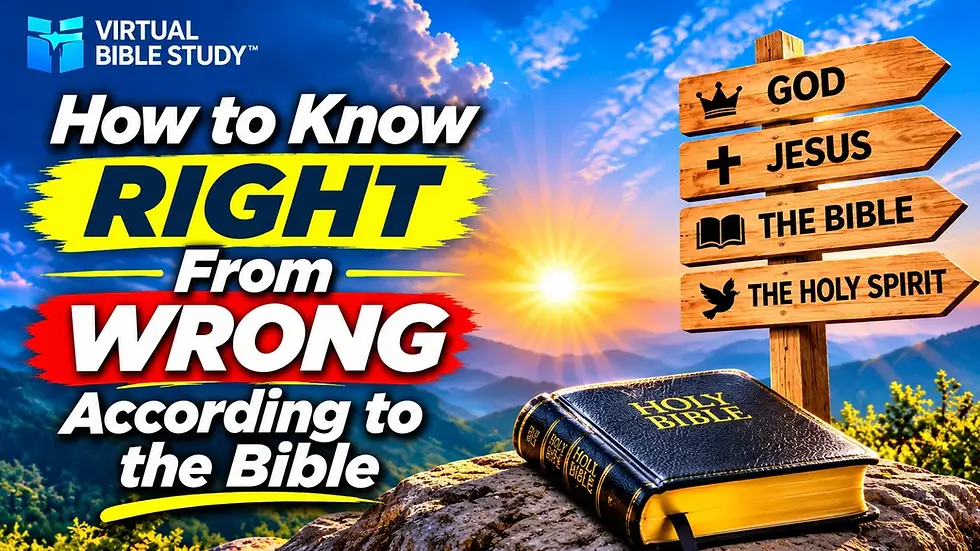
HOW TO KNOW RIGHT FROM WRONG ACCORDING TO THE BIBLE
To understand how to know right from wrong according to the Bible, Christians can rely on four sources of guidance: God Himself, Jesus, the Bible, and the Holy Spirit. These four sources serve as our moral compass and will never contradict one another because they all originate from God. The more time we spend studying God's Word, the better equipped we become to determine right from wrong and make decisions according to God's standards rather than the world's.
1. God
“But if any of you lacks wisdom, let him ask of God, who gives to all generously and without reproach, and it will be given to him.” — James 1:5 NASB
2. Jesus Christ
Jesus is our perfect example. His teachings and example show us how to live godly lives.
3. The Bible
“All Scripture is inspired by God and beneficial for teaching, for rebuke, for correction, for training in righteousness; so that the man or woman of God may be fully capable, equipped for every good work.” — 2 Timothy 3:16–17 NASB
4. The Holy Spirit
The Holy Spirit is sent from God to help us navigate life, as seen in the following Scripture:
“Now we have received, not the spirit of the world, but the Spirit who is from God, so that we may know the things freely given to us by God.” — 1 Corinthians 2:12 NASB
Full Bible Study
How to Know Right From Wrong According to the Bible
What is right, and what is wrong?
And who decides?
These are important moral questions that all of us must answer for ourselves.
Is determining right from wrong a feeling, or is it something that we have to be taught?
Spoiler alert!
It is both.
Sometimes telling right from wrong is obvious.
Other times, it can be more difficult for us to decipher.
As Christians, we must understand the four sources that we have been provided with to help us determine right from wrong:
1. God,
2. Jesus,
3. The Bible,
4. The Holy Spirit.
These are the only sources that we can trust one hundred percent of the time to help us determine right from wrong.
That does not mean that these are the only sources for determining right from wrong.
Of course not!
But they are the only sources that come directly from God.
And they are the standards that we will be held to on the Day of Judgment.
FOLLOWING OUR HEARTS
There are a lot of people who give the advice that when it comes to making a moral decision, we should all just “listen to our hearts.”
This advice can be very convincing, but is that what God wants us to do?
Before you answer that question, consider the following scripture:
“There is a way which seems right to a person, but its end is the way of death.” – Proverbs 14:12 NASB.
Satan is a master of deception.
Sometimes he will try to tempt us into doing things that we know are wrong.
And he is persistent!
Other times Satan will be much more subtle in his approach.
There are times when we start out doing something that we think is right, and then something changes, or there is a new element that we must consider.
When this happens, it is easy to become confused.
That is why it is so important that we understand all of the resources that God has provided us with to help us make righteous decisions.
JESUS
Jesus is God’s only child, and from what we read in the Bible, He always obeys His Father.
Nowhere is that more evident than in the following text where Jesus is in the Garden of Gethsemane praying to God shortly before His crucifixion.
Then Jesus came with them to a place called Gethsemane, and said to His disciples, “Sit here while I go over there and pray.” And He took with Him Peter and the two sons of Zebedee, and began to be grieved and distressed. Then He said to them, “My soul is deeply grieved, to the point of death; remain here and keep watch with Me. And He went a little beyond them, and fell on His face and prayed, saying, “My Father, if it is possible, let this cup pass from Me; yet not as I will, but as You will.” And He came to the disciples and found them sleeping, and said to Peter, “So, you men could not keep watch with Me for one hour? Keep watching and praying that you may not enter into temptation; the spirit is willing, but the flesh is weak. He went away again a second time and prayed, saying, “My Father, if this cannot pass away unless I drink it, Your will be done.” – Matthew 26:36-42 NASB.
While Jesus was on Earth, He taught about how God wants us to live our lives in scriptures like these:
-
“When Jesus saw the crowds, He went up on the mountain; and after He sat down, His disciples came to Him. He opened His mouth and began to teach them .” – Matthew 5:1-2 NASB,
-
"Now there was a man of the Pharisees named Nicodemus, a ruler of the Jews. This man came to Jesus by night and said to him, “Rabbi, we know that you are a teacher come from God, for no one can do these signs that you do unless God is with him.” - John 3:1-2 NASB,
-
Now Jesus was praying in a certain place, and when he finished, one of his disciples said to him, “Lord, teach us to pray, as John taught his disciples.” And he said to them, “When you pray, say: “Father, hallowed be your name. Your kingdom come. Give us each day our daily bread, and forgive us our sins, for we ourselves forgive everyone who is indebted to us. And lead us not into temptation.” – Luke 11:1-4 NASB.
We can always rely on the teachings of Jesus to help us determine right from wrong.
THE BIBLE
Another source that God has provided us with to help us determine right from wrong is the Bible.
The Bible is not the thoughts of man, nor is it a bunch of interesting stories that were put together in a book for us to enjoy.
The Bible is the inspired Word of God!
The Apostle Paul wrote about this in his second letter to Timothy:
-
“All Scripture is inspired by God and beneficial for teaching, for rebuke, for correction, for training in righteousness; so that the man or woman of God may be fully capable, equipped for every good work.” – 2 Timothy 3:16-17 NASB.
This scripture is great news for us because it tells us that every word of the Bible is inspired by God.
Not some of the words, all of them!
God has given us the inspired words of the Bible to help us because He loves us.
He knows what we need because He created us.
Paul’s second letter to Timothy contains the following inspired words:
-
“Be diligent to present yourself approved to God as a workman who does not need to be ashamed, accurately handling the word of truth.” –2 Timothy 2:15 NASB.
In this letter, Paul was encouraging Timothy to remain faithful in his study of God’s Word so that he would be able to properly divide it and apply it.
The same holds true for us.
If we do not study and meditate on God's Word to understand what it says, how can we expect to properly apply it to our lives?
We cannot.
And that is why it is so important to study the Bible often.
THE HOLY SPIRIT
The final source that God has provided us with to help us determine right from wrong is the Holy Spirit.
At times in our lives, we will have questions that we are not able to answer directly from the Bible.
It is in these times that the Holy Spirit can help guide us.
That is exactly what the Holy Spirit is for.
God sent Him to help us:
-
“But the Helper, the Holy Spirit, whom the Father will send in My name, He will teach you all things, and bring to your remembrance all that I said to you.” –John 14:26 NASB.
Think of it this way, the Bible teaches us what we are to do, and the Holy Spirit lets us feel it.
The Bible and the Holy Spirit are always in agreement because they both come directly from God.
The same can be said about Jesus.
Jesus, the Bible, and the Holy Spirit will never contradict one another because they all come directly from God.
John wrote about this in his first epistle:
-
“By this, you know the Spirit of God: every spirit that confesses that Jesus Christ has come in the flesh is from God; and every spirit that does not confess Jesus is not from God; this is the spirit of the antichrist.” – 1 John 4:2–3 NASB.
CONCLUSION
How we determine right from wrong is incredibly important to our salvation.
That is why, as Christians, we must understand what God's standards are and how He defines right from wrong.
In today’s lesson, we discussed four sources that God has provided us with to help us determine right from wrong.
-
God Himself,
-
Jesus,
-
The Bible,
-
The Holy Spirit.
These four sources are our “true north” and should act as our moral compass.
God, Jesus, the Bible, and the Holy Spirit will always agree with one another, and never contradict one another, because they all originate from God, and are of God.
The more time we spend in God’s word, the better we will become at determining right from wrong.
Not according to the world’s standards, but more importantly, by God’s!
We will end today’s lesson by revisiting Paul’s second letter to Timothy.
In this letter, Paul reminds us to devote time to being in God’s word so that we can properly interpret it and apply it to our lives.
-
“Be diligent to present yourself approved to God as a worker who does not need to be ashamed, accurately handling the word of truth.” – 2 Timothy 2:15 NASB.
Question 1
How do you think most people in our society determine right from wrong? Rank these from most influential to least influential.
- Feelings
- Upbringing
- Friends
- Social media/culture
- The Church
- The Bible
- Something else?
Question 2
What are the four sources God has given us to determine right from wrong? Why do you think He gave us four instead of just one?
Question 3
When you're faced with a difficult moral decision, what influences you the most? Rank the following from highest impact to lowest.
- Feelings
- Upbringing
- Friends & family
- My church
- The Bible
- Prayer / the Holy Spirit
- Something else?
Follow-up: Has that always been true for you, or have your rankings changed over time?
Question 4
Can friends and family help us determine right from wrong, or can they sometimes lead us in the wrong direction? Share an example.
Follow-up: Why do you think it's so hard to recognize bad advice when it comes from people we love?
Question 5
What are the real-life consequences of using the wrong standard to determine right from wrong in our own lives and in our relationship with God?
Reflect on the Lesson
Consider these questions on your own or discuss them with others.